mount_oregano: novel cover art (Semiosis)

For Shawn Thompson, curiosity is a way to live in a deeper and more fulfilling way. That’s what he explores in his podcasts. He wondered how I found a way to write from the point of view of a plant in the novel Semiosis, so we had a chat about the craft of imagination in writing, curiosity, first contact, and alien intelligence.

You can watch us on YouTube here:

Episode 1: https://youtu.be/k-PsnhuqC3U

Episode 2: https://youtu.be/rLsPkECqac4

Episode 3: https://youtu.be/wwtgan1j8jw

Curious podcast channel: https://www.youtube.com/@theoldcuriositypodcast

mount_oregano: portrait by Badassity (Default)
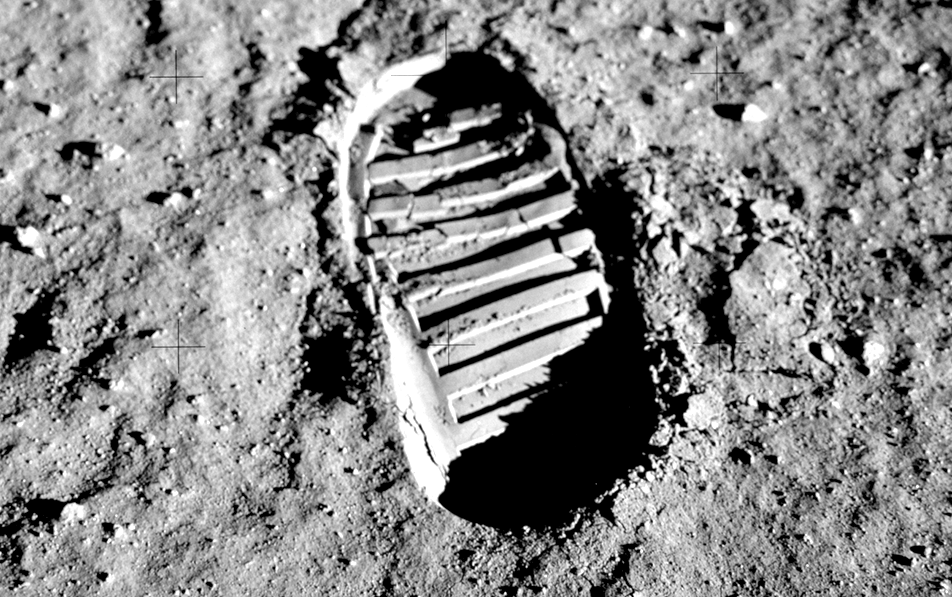
Photo of a bootprint in the dust on the Moon

Once again, you curse the gods of literature: Your “short story” turned out to be the first chapter of a novel, and you really wanted a short story. How do you keep things short? Try to limit the number of important characters to two or three. Use one point of view. Keep the conflict simple, the way that postage stamp artwork is memorable but simple. Compress the time frame. Aim for a single effect. Include only the most essential information. If you need a short story idea, here are a few.

• This is a fantasy story in which a gem broker becomes obsessed over a new kind of stone that appears at a roadside market.

• This is young adult story in which a panic-stricken alien learns self-defense from a dog.

• This is a competence p0rn story about an incorrigible lunar pioneer who endangers the settlement by sloppy habits that introduce lunar dust, which has damaging and dangerous sharp edges, into living and working quarters.

mount_oregano: novel cover art (Semiosis)


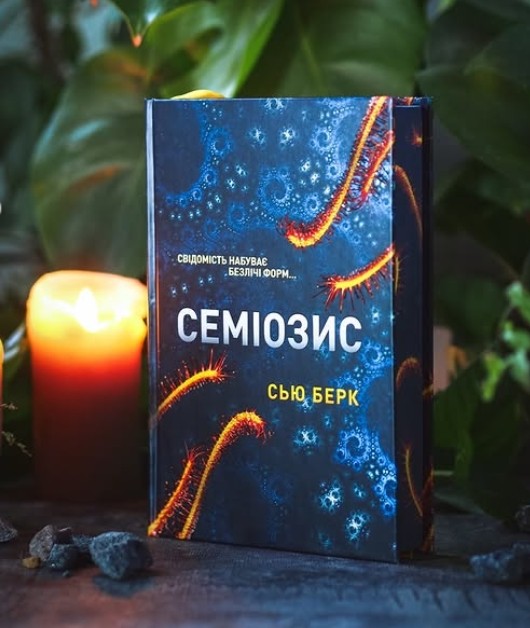
The novel Semiosis is now available in Ukrainian from Lobster Publishing.

This has to be the most beautiful edition of the book, as you can see in these Instagram reels.

I know just enough of the Cyrillic alphabet to know that СЕМІОЗИС is Semiosis and Сью Берк is Sue Burke.

Meanwhile, my heart breaks for the people of Ukraine. I visited Kyiv in 2006 when it hosted the European Science Fiction Convention, and I was impressed by the elegance of the city and the patriotism of its people. They made sure, back in 2006, that I understood they were not Russian.

mount_oregano: Let me see (judgemental)

Here are some things published in 2025 that you may wish to consider nominating for an award — just a reminder. Some are my own works, some are my translations.

Science fiction and fantasy short stories by me

“To Defeat Water” Short story, 1175 words. If you curse Poseidon, he might curse you, too, time and time again. And life after life, you can fight back. Read it here: The Lorelei Signal, July 2025.

“Journey to Apollodorus” Novelette, 8760 words. In my novel Dual Memory, an AI named Par Augustus discovers a story about robots in the Apollodorus Crater on Mercury. This is the story. It focuses on the humans who struggle to create and maintain a scientific team when a lander sent to Mercury behaves unexpectedly. Success can be as stressful as failure. Oxygen Leaks Magazine, March 2025 (no longer in publication, contact me for a copy).

Novella translation

ChloroPhilia by Cristina Jurado. Translation of a novella, 20,200 words. Would you sacrifice your humanity to save the world? Nominated for Spain’s Ignotus Award, this strange coming-of-age story addresses life after an environmental disaster, collective madness, and sacrifices made for the greater good. Buy it here: Apex Books, January 2025.

Science fiction short story translations

“Trees at Night” by Ramiro Sanchiz. Translation of a short story, 6050 words. A librarian at a hospital-like sanatorium befriends a young patient named Federico for reasons that eventually become clear. Read it here: Clarkesworld Science Fiction and Fantasy Magazine, November 2025.

“Proxima One” by Caryanna Reuven. Translation of a short story, 4020 words. A machine intelligence called Proxima One sends probes into the galaxy on long journeys filled with waiting and yearning in a search for intelligent life. The probes cope with unexpected wonders, loss, and profound changes — but there is always possibility and hope. Read it here: Clarkesworld Science Fiction and Fantasy Magazine, May 2025.

“Bodyhoppers” by Rocío Vega. Translation of a short story, 5290 words. Minds can hop from body to body, but there’s always a problem because the system is designed to create them. One day, you can’t return to your own body because it’s occupied by someone with more money. Now you have no home, and you’re still madly in love. Clarkesworld Science Fiction and Fantasy Magazine, February 2025.

Poetry translation

Liquid Sand / Arena Líquida by Jorge Valdés Díaz-Vélez. Book of poetry translated by Christian Law Palacín and myself. This is the first major bilingual collection of poems by Jorge Valdés Díaz-Vélez, one of Mexico’s most respected contemporary poets. It gathers 42 of his works selected from six previous collections that span more than two decades of writing. Shearsman Books, November 2025.

mount_oregano: Let me see (judgemental)

The 30th annual Parsec Short Story Contest is open for submissions until March 31, 2026. This year’s theme is “metamorphosis.” Entries should be unpublished and be no more than 3,500 words. The contest is open to writers who have not met the eligibility requirements for SFWA full membership. No entry fee. Full contest rules and information are here.

The winners will be chosen by a team of three judges. I’m one of them. What will I be looking for? A good story, well told, of course. I’ve judged other contests, and I’ve seen a number of otherwise excellent stories that drop the ball at the end. The manuscript reaches “the end” a paragraph or two before the story does, failing to complete the emotional arc of the characters. Just saying. Good luck!

My flash fiction piece “The Souvenir You Most Want” won second place in the 2002 Parsec Contest, which had the theme “Met by Moonlight.” Read it here.

My short story “Think Kindly on Our Fossils” appears in the 2007 Triangulation: End of Time anthology, published by PARSEC Ink. You can purchase it here.

mount_oregano: portrait by Badassity (Default)

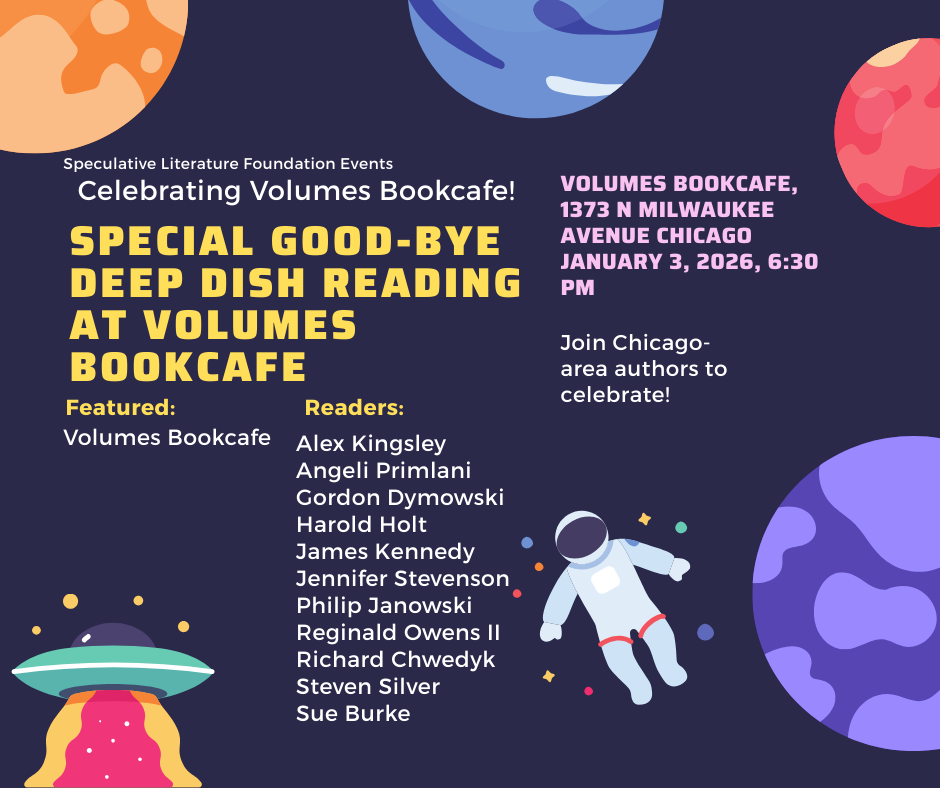
Volumes Bookcafé is closing its doors. The bookstore in Chicago’s Wicker Park neighborhood, owned by two sisters, lost too much business when a Barnes & Noble opened two blocks away. This is the store that hosted all my book launches. Rebecca, one of the owners, has become a friend.

To say goodbye, the Speculative Literature Foundation will host a Deep Dish reading at the store at 6:30 p.m. Saturday, January 3, 1373 N. Milwaukee Ave., Chicago. Come, enjoy the performances, and buy a book. Volumes has a carefully curated selection.

The readers will be Alex Kingsley, Angeli Primlani, Gordon Dymowski, Harold Holt, James Kennedy, Jennifer Stevenson, Philip Janowski, Reginald Owens II, Richard Chwedyk, Steven Silver, and me.

I’ll be reading two poems, “Petty Love” and “Sonnet from Hell.”

mount_oregano: Let me see (judgemental)


Let’s start with Spain, since I used to live there. The word of the year for 2025 is arancel (tariff), according to Fundéu, which advises on questions about Spanish language use for news reporting. Due to US policy changes, issues of tariffs for imports and exports have been in the news a lot in Spain.

The runners-up give a peek into other issues in Spanish news: apagón (power outage), macroincendio (massive wildfire), preparacionista (prepper), boicot (boycott), dron (drone), generación Z (Generation Z), macrorredada (massive roundup, specifically ICE arrests in the US) rearme (rearm, as with weapons), papa (pope), tierras raras (rare earths), and trumpismo (Trumpism).

The Economist magazine, Australia’s Macquarie Dictionary, and Merriam-Webster Dictionary all chose slop. “Slop merchants clog up the internet with drivel,” the Economist opines. Merriam-Webster defines slop as “digital content of low quality that is produced usually in quantity by means of artificial intelligence.” The Macquarie definition specifies “low-quality content created by generative AI, often containing errors, and not requested by the user.” All three sites have long lists of runner-up words.

For Oxford University Press, the word is rage bait, “online content deliberately designed to elicit anger or outrage by being frustrating, provocative, or offensive, typically posted in order to increase traffic to or engagement with a particular web page or social media account.” Oxford adds, “The Oxford Word of the Year can be a singular word or expression, which our lexicographers think of as a single unit of meaning.” The runners-up are aura farming and biohack. (Robert Reich points out that rage bait is profitable.)

Dictionary.com chose 67 for 2025. “Most other two-digit numbers had no meaningful trend over that period, implying that there is something special about 67,” the site informs us, adding that “we’re all still trying to figure out exactly what it means.” Dictionary.com’s runners-up include an emoji. Both CNN and AP agree 67 can be annoying. The comic xkcd has additional information about funny numbers.

Canada’s Queens University picked maplewash, “the deceptive practice of making things appear more Canadian than they actually are.” That is, maplewashing encourages buying Canadian-made products rather than US imports. The word edged out elbows up. Both words speak to our times, and as an American, I apologize to our nice neighbors to the north.

Cambridge chose parasocial: “involving or relating to a connection that someone feels between themselves and a famous person they do not know, a character in a book, film, TV series, etc., or an artificial intelligence.” It adds, ominously, “The emergence of parasocial relationships with AI bots saw people treat ChatGPT as a confidant, friend or even romantic partner. These led to emotionally meaningful – and in some cases troubling – connections for users, and concerns about the consequences.” Sloppy consequences.

Collins Dictionary picked vibe coding, which “refers to the use of artificial intelligence prompted by natural language to write computer code.” (See also: slop.) Collins, too, has a runner-up list, and some of those terms will sound familiar.

Global Times reports that the Trilateral Cooperation Secretariat has chosen future as the China-Japan-South Korea Spirit Word of the Year. The secretary-general of TCS said future reflects the optimism and determination of the people of China, Japan, and South Korea to build closer ties in the future.

Time chose “the architects of AI” as Person of the Year 2025. (See also: slop.)

Pantone chose its color of the year, Cloud Dancer, “a lofty white that serves as a symbol of calming influence in a society rediscovering the value of quiet reflection. A billowy white imbued with serenity, PANTONE 11-4201 Cloud Dancer encourages true relaxation and focus, allowing the mind to wander and creativity to breathe, making room for innovation.”

As reported by NPR and Today, not everyone is impressed by the color, although Homes and Gardens points out that “white is timeless.” I should mention that my home office is painted white. In my case, it’s because I was too lazy to think harder.

mount_oregano: portrait by Badassity (Default)
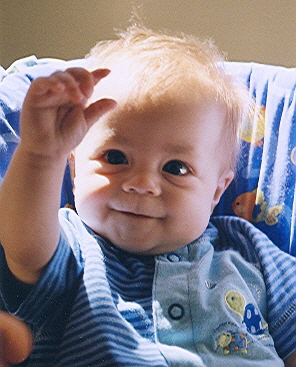
Photo of Sean as a baby

I wrote this piece as a Christmas present for my nephew in 2004.


This is your first Christmas, Sean, and since you’re only eight months old, I know this story might not impress you much, but it seems like the right time to tell it.

Your father was not quite three months old on his first Christmas, and I was ten years old. I knew enough about babies to know they don’t really do much at first, but eventually they grow into real people. That was the exciting puzzle. What was this new baby brother going to be like? We didn’t have many clues, but we watched for them all the time. Who was Louis Peter Burke?

Your Grandmother Burke died well before you were born, so you don’t know much about her. Here is her Christmas tree decorating theory: More is better. In architectural terms, it was rococo baroque.

During Christmas Eve day, we decorated the tree. First the lights went on — big lights, small lights, steady lights, twinkle lights, colored lights, white lights, all the lights we had, and there were plenty. Second, we hung every single ornament we had on the tree, and, again, there were plenty. If one was ugly or beat up, it went way in the inside where it could add color or sparkle without really being visible. The only rule was smaller stuff on top, bigger stuff on the bottom. Finally, we added tinsel and garlands of various types and colors to be sure there was maximum sparkle.

Then we waited for nightfall, since only a darkened house could do justice to the masterpiece we had created.

Meanwhile, we dressed your father in a red-and-white-striped elf-costume pajama set that an aunt had given him, complete with a pointy cap. He didn’t care for the cap but we made him wear it anyway, at least long enough for a photo, which may still be around somewhere. He looked more silly than elfish. He certainly had no idea about what was going on. He was too little to understand much of anything.

The moment to light the tree arrived. We turned out all the lamps and closed the front curtains to block the streetlight. With a flip of a switch, the tree flashed on, providing enough sparkling light to read by.

Your father’s eyes got big and he couldn’t take them off the tree. He liked it! He liked it a lot! Even when we turned the room lights back on, he continued to stare at the tree, fascinated.

It was a clue, the first clue I remember, about your father’s personality. He liked colorful, beautiful things — at least, we thought the tree was beautiful, and in a rococo way, it certainly was. We lit the tree for him throughout the holidays for the sheer fun of watching him enjoy it.

I don’t remember much else about that Christmas, like what I got as presents, what anyone else got, whether there was snow, or what we had for Christmas dinner. All I remember is the intense look of surprise and delight on your father’s little face, and how merry a Christmas he made it for all of us because we could make him happy, and because we had learned a little bit about him.

Finding out who someone is takes a long time. I’m still learning things about my brother Louis. Fatherhood, for example, has revealed new aspects of his personality and interests. In the same delighted way that I first saw so many years ago, he could not be more curious and excited to learn about you. Who is Sean Patrick Burke?

This is your father’s first Christmas with you. I hope it is merry.


Copyright © 2004 by Sue Burke, all rights assigned to Sean Patrick Burke.

mount_oregano: portrait by Badassity (Default)

a row of house plants with garlands and baubles 

I shouldn’t have been surprised that my living room plants had organized. There’s a lot of community-building going on these days, especially here in Chicago.

“I speak for all of us,” the dragon tree said. “You marched for No Kings, so why are you thinking about decorating us? This holiday is for Three Kings. That’s three times worse.”

It took me a moment to figure out what they were talking about. Every year, one of my houseplants impersonates a Christmas tree. This year, they were a little on edge, understandably. It’s been a rough year.

“Let me tell you the holiday story,” I said. Plants are attentive, and they listened quietly. “So you see, the Three Kings are wise men.”

“Wise. Completely different kings, then. If we’re decorated, we’re protesting in favor of joy to the world, right? In that case, we all want to be decorated. The living room will be a massive pro-holiday rally.”

Every year, the plants have opinions about holiday decorating, and I’ve learned that plants are stubborn. So, this year, everyone gets to celebrate. It’s the season of joy and community around here. Happy holidays to you, too.

mount_oregano: portrait by Badassity (Default)

Rejections and fun don’t mix – except this one time.

I wrote a horror story about vampires and started sending it out. The story made the second cut in an anthology but not the final one. Oh, well. I sent it out again right away and got a response of “close, very close” from the editor. Not bad!

Then … the very next magazine rejected it with a note saying that it was “cruel and evil.” Evil? A vampire horror story? Isn’t that the point? I laughed about it with my writer friends, and for a while I was known as “the evil Sue Burke.”

The next magazine rejected it with (this was by snailmail) a preprinted note saying: “We celebrate your achievement!” Although the editors couldn’t take the story, the note said, they wanted me to know how proud they were of me for having written it and taken part in the furtherance of literature. Or something like that. I think they meant it because they dropped a sprinkle of confetti into the envelope — really cool confetti. I used it to decorate my desk lamp.

I kept sending the story out, got rejections both bland and encouraging, and on the 21st try, I found a magazine that loved it and took it. A few years later the story was even reprinted in an anthology. All’s well that ends well.

I learned four things from this adventure:

1. Confetti should accompany all rejections. Or, now that we send most things out via internet, a picture of a cute kitten. How hard would that be?

2. Rejections are about the story, not about the writer, which is too bad because I’d really like to be evil.

3. As we all know, rejections are a necessary step toward publication. We can even make a game out of them. I wish I could remember who I learned this from so I could give her credit: Try to see if you can achieve a certain number of rejections in a single day. She suggested five, so I made that my goal. The most I’ve ever gotten is three.

4. I need more rejections if I’m ever going to win the rejection game, which means I have to get more submissions out there. So, if you’ll excuse me, I’m going to go write something, and as a parting gift, here’s a picture of a cute kitten. Celebrate your next rejection with it. We all deserve a little fun.


Cute kitten
mount_oregano: portrait by Badassity (Default)

Here are some writing prompts. If any of these prompt a story or idea for you, go for it! Ideas a free, and you can use these prompts freely any way you want.

“An angry man — there is my story: the bitter rancor of Achilles…” Thus Homer begins The Iliad. When does a story begin? To answer that question, you should understand your story thoroughly. Author John Kessel says a story begins when a situation loses balance. Homer begins his story when Agamemnon insults Achilles at the siege of Troy, they fight, and as a result, soon the souls of champions glut Hell while dogs and ravens feast on their corpses. Star Wars begins when Princess Leia sends a desperate plea for help that falls into the hands of her long-lost brother (spoiler, sorry) who, eventually, tries to destroy the evil Empire.

Here are some possible story beginnings:

• This made-for-TV movie begins when a wildlife biology crew comes to a ghost town on Mars to study the creatures who have made homes in the empty buildings.

• This cyberpunk story begins as artificially reformed convicts try to make their way in a society that doubts their transformations — transformations they themselves doubt.

• This story begins with Rio, the first baby born after the human population exceeds the supply of souls available for reincarnation.

mount_oregano: portrait by Badassity (Default)
Pumpkin pie, some assembly required. This pumpkin came from Waupun, Wisconsin, which explains its classic appearance.

Pumpkins are squashes, but are squashes pumpkins? Some are. Regarding your holiday pumpkin pie, if the pumpkin comes from a can, it’s at least 95% certain that it is from the Dickinson pumpkin, which is more or less a butternut squash. But as Libby’s Pumpkin insists, the Dickinson is really a pumpkin—and that’s true. Botanically speaking, “pumpkin” is a squishy squashy category.

Anyway, I can attest that a good butternut squash/Dickinson pumpkin is a little more flavorful than the classic pie pumpkin, so don’t feel cheated. And both of those taste better than the variety of pumpkin we carve for Halloween. A jack-o-lantern makes a great addition to the compost heap, not the dinner table.

One more fun fact: Almost all pumpkins for canned pie filling are grown in and around the village of Morton, Illinois, near Peoria. So when you eat your pumpkin pie, think about the Land of Lincoln. In these fraught political times, what can we learn from Honest Abe?

Happy Thanksgiving.


mount_oregano: portrait by Badassity (Default)

Anthologies tend to make less money than novels, yet they keep appearing. And I keep reading them. An anthology offers the chance to read a carefully curated selection, and I love short stories as an art form.

Apex Book Company asked me if I’d like to read an advanced copy of ECO24, The Year's Best Speculative Ecofiction, and offer a blurb if I liked it.

I liked it a lot. Like every good anthology, the stories offer a range of approaches, including literary science fiction, magical realism, and dark fantasy. Some are set in the present, such as the war in Ukraine, others in the future, and they feature settings around our planet and beyond. Some are grim, many hopeful.

My favorite is “The Plasticity of Being” by Renan Bernardo, which illustrates the paradoxes of offering help to poor people. I also especially enjoyed “Bodies” by Cat McMahon about the dangers of being a clone, and “Thirteen Ways of Looking at a Blackened Husk of a Planet” by Adeline Wong about the emotional weight of being a student, with hints of poetry. But I could go on. There’s the quiet wisdom of “Batter and Pearl” by Steph Kwiatkowski, and the aspiration of “Father Time Dares You to Dream” by Trae Hawkins — and both stories take place near me.

My blurb:

Each author offers us a unique ecological niche to reveal what our present and future could be, ranging from wrenching disasters to elating possibilities of recovery. These stories are personal and lyrical, and the breadth of imagination and styles make this anthology dazzling. Every story is a gem.


mount_oregano: and let me translate (translate)

Cover of book


I translated the poems in Liquid Sand / Arena Líquida with my Spanish friend Christian. One of us would draft the translation of a poem, then we would pass it back and forth, debating words, lines, and meaning — the goal of a translation is always to maintain the meaning. We didn’t quibble much. Translation is easiest when the original work is well-written.

In the opening poem, “Nadie / No One,” Ulysses returns to Ithaca to become a specter among his own memories. While there’s no way to summarize a collection of 42 poems, the theme of time occurs often. Time moves, and we move, but in different directions for different reasons, as the poem “Negro Sol / Black Sun” says:

The afternoon weighs heavily

toward its settlement. Ours

is due to a harder sun

and we have had to learn

to walk beneath its burden.

Liquid Sand / Arena Líquida is the first major bilingual collection of poems by Jorge Valdés Díaz-Vélez, one of Mexico’s most respected contemporary poets. Published this month by Shearsman Books and available from most bookstores, it gathers works by Valdés Díaz-Vélez selected from six previous collections that span more than two decades of writing.

Madrid Review Magazine says:

“In these pages, Valdés Díaz-Vélez explores time, memory, and the fragile equilibrium between movement and stillness. His poems evoke the physical and emotional geographies of the Americas while questioning belonging, transformation, and endurance. The English versions retain the clarity and meditative strength of the originals, inviting readers to cross the line between two languages and two sensibilities. To read Liquid Sand / Arena Líquida is to encounter poetry that is precise, reflective, and alert to the unseen rhythms of contemporary life. It is a landmark publication for readers of bilingual and Latin American literature.”

mount_oregano: and let me translate (translate)

A story I translated from Spanish by Ramiro Sanchiz, “Trees at Night” (Árboles en la noche) is in the November 2025 issue of Clarkesworld Science Fiction and Fantasy Magazine. A podcast of the story is read by Kate Baker. Both are free to enjoy.

Sanchiz is a Uruguayan writer, and this story is part of his literary project that explores permutations of a universe that revolves around a character named Federico Stahl. You can read “Arboles en la noche” in the original Spanish at the magazine Contaminación futura 8.

In the story, a librarian at a hospital-like sanatorium befriends a young patient named Federico for reasons that eventually become clear.

I recommend this story, among other reasons, as a masterful example of in medias res: beginning a story in the middle of the action or plot. Science fiction often does this, and SF readers are used to it, but I’ve seen readers of mainstream and literary fiction sometimes get so flummoxed that they give up because they don’t immediately understand what’s happening. SF readers have learned that a good story in this style will explain all the things in the end, and the fascination of the story is the discovery.

This haunting work offers a distant echo of the novel Roadside Picnic by Arkady and Boris Strugatsky (which I recommend): aliens come to Earth, and what they leave behind seems incomprehensible to humans.

mount_oregano: Let me see (judgemental)


Since it’s Halloween, let me tell you a true story about a ghost. I don’t believe in ghosts, but I want to believe in this one. It happened quite a few years back when I was living in Milwaukee and I went to visit a friend’s house in the Bay View neighborhood.

I didn’t know the house was haunted. I simply said the big, colorful framed poster hanging at the top of the stairs looked lovely, especially in that spot.

“Do you want to know why it’s there?” My friend was eager to tell me. She and her family had moved into the house not long ago, and they had decided that the space at the top of the stairs seemed like a natural place for art, which it was.

So they hung up a picture. It fell down. They put it up again. It fell down the stairs and broke. They tried another picture, carefully securing it to the wall, and it, too, fell down the stairs and broke. They couldn’t figure out what the problem was.

Then one day they were talking with the elderly neighbor who had lived next door all his life. He listened to their story and sighed sadly. Decades earlier, the family in that house had a teenage son who was gay, which in those days was a terrible taboo, so he had committed suicide by throwing himself down the stairs. Ever since then, things fell down the stairs for no reason — or perhaps because the boy was still there in spirit.

My friend and her family decided to try an experiment. They bought the most beautiful gay rights poster they could find, put it in a nice frame, and hung it at the top of the stairs, hoping the boy might understand that things had changed.

“And it’s still there!” she said. “I’m not sure I believe in ghosts, but maybe we helped his spirit rest in peace.”

Now, I knew the neighborhood. The street in front of that house was built over an underground stream, Deer Creek. Maybe, when heavy trucks went past, they made the ground shake and the movement somehow focused on that stairway.

Or maybe there was a troubled spirit in that house, a forlorn teenage boy who had lived there many years ago. And possibly, if he had been born decades later, he could have lived at peace with himself and still be alive.

mount_oregano: portrait by Badassity (Default)


Come to the Deep Dish Reading at 6 p.m. Thursday, Oct. 23, at After-Words Bookstore, 23 E. Illinois St., Chicago, organized by the Speculative Literature Foundation. Featuring Devi Bhaduri, Tina Jens, Philip Janowski, Brendan Detzner, Harold Holt, Katherine Ervin, Winifred Burton, and Sue Burke.

I’ll be reading this short piece called “Intricate Stardust.”


mount_oregano: Cover art of the novel USURPATION (Usurpation)

If you haven’t yet read Usurpation, here’s your chance to buy it at a more economical price. The trade paperback will be released on Tuesday, October 21, available from any bookseller.

This is the third book in the Semiosis trilogy. As you may recall, Stevland, an aggressive, intelligent plant on a distant planet, longs to send his seeds to Earth. In the second book of the trilogy, Interference, he finds a way.

Now Stevland’s descendants grow everywhere, but no one on Earth knows they are intelligent, and humans have fallen into a violent crisis. They need help. But how? Stevland sends advice: “Compassion will give you courage. Love will be ferocious.”


mount_oregano: and let me translate (translate)

Back in my college days, in a Survey of Spanish Literature class, I discovered the Spanish author Azorín, who would become one of my favorite writers. A sentence he wrote about how to write became my watchword:

No basta hacerse entender; es necesario aspirar a no poder dejar de ser entendido

It is not enough to make yourself understandable, it is necessary to aspire to be unable to be misunderstood.

More recently, I’ve been studying Latin (you never know when you’ll need to summon a demon), and I came upon this quote by Quintilian, a Roman educator whose lessons have never been forgotten:

Quare non, ut intelligere possit, sed, ne omnino possit non intelligere, curandum.

It is not enough to use language that may be understood, but to use language that must be understood.

Down a rabbit hole, I discovered that this sentence comes from Quintilian’s discussion of strategies of persuasion, in particular how to persuade someone who may be distracted while you speak. His advice has been an inspiration to many people right up to our own 21st century. Apparently Azorín came upon it somehow, and it inspired him, too.

However, I later came upon a corollary that has proven to be true uncountable times, sadly — so good luck out there:

Anything that can be misunderstood has been misunderstood.


mount_oregano: portrait by Badassity (Default)
Apple trees

Apples are my favorite fruit — but is it the forbidden fruit? Probably not. The idea seems to have come from a mistranslation or artistic liberty rather than the gospel truth.

The Bible’s Book of Genesis tells the story of the serpent who talks to Eve about a particular fruit that, if she ate it, would cause her to “be as gods, knowing good and evil.” (Gen. 3:4, St. James Version). It doesn’t say which fruit, and many different fruits have been proposed. The idea that it’s an apple could come from a confusion between the Latin word “malus” for evil and “malum” for apple. Or the Latin word “pomum” for fruit; in French, it became “pomme” and eventually meant apple. Or the Biblical story became mixed with Greek legends about apples.

In any case, apple trees are a good example of how plants manipulate us. Apple trees grow tasty fruit so that we pick it, eat it, and spread the seeds when we toss away the core. Like many kinds of fruit, some varieties of apples even change color as they ripen to encourage us to eat them. Apple trees now grow all over the planet and enjoy tender loving care. Like every plant, apples want to take over the Earth — or at least conquer every niche they can fit into. Apples have used us humans to achieve world domination.

It’s apple season. Enjoy! And consider the mutualism that brings you this sweet treat. Just because you eat something, you might not be the apex predator. You might be cheap labor.


Page generated Jan. 26th, 2026 11:52 am
Powered by Dreamwidth Studios